From Repossession to Revelation: The High School Dropout Who Turned America's Castoffs Into a Cultural Landmark
The Education Nobody Planned For
Dale Mercer dropped out of high school at seventeen with no plan and a secondhand truck. He wasn't lazy, exactly — he just couldn't sit still long enough for a classroom to hold him. So he did what a lot of young men in mid-Ohio did in the early 1980s: he found work that kept his hands busy and his mind from wandering too far.
That work turned out to be repossession. A cousin ran a small recovery outfit — cars, mostly, but sometimes farm equipment, restaurant fixtures, even the occasional boat — and he needed a second driver who didn't ask too many questions. Dale fit the bill.
What happened next took about a decade to become obvious.
Learning Loss From the Inside
There's a particular kind of education you get when your job is to show up at three in the morning and take something away from someone who can no longer afford it. You learn, very quickly, how to read value. Not market value — real value. You learn that a 1967 Ford pickup sitting in a foreclosed lot might be worth more than anyone on paper is claiming. You learn that a diner's chrome counter stools, scheduled for the junkyard, are exactly the kind of thing somebody, somewhere, would pay serious money to own.
Dale started keeping notes. Nothing formal — just a spiral-bound notebook he'd jot things into after jobs. Descriptions of objects. Rough estimates of what he thought they were worth versus what the lenders thought. Over time, the notebook became a kind of field guide to American material culture as seen through the lens of financial ruin.
"I was basically getting a museum education," he'd later tell a reporter from the Columbus Dispatch, "except the tuition was other people's bad luck."
By his late twenties, he'd developed a side business buying items outright from lenders before they went to auction — pieces he recognized as undervalued, things he couldn't quite bring himself to watch get crushed or scattered. He rented a storage unit. Then two. Then a warehouse.
The Warehouse That Wouldn't Stay Empty
The warehouse was in Zanesville, Ohio — a town with more history than most people stop long enough to notice. Dale leased it in 1991 for next to nothing because the roof leaked and the heating system was held together with optimism. He spent three years fixing it up on weekends, moving things in, arranging and rearranging.
At first, he had no idea what he was building. He thought maybe a flea market. Then an antique store. His girlfriend at the time suggested he just call it a museum and start charging admission, half-joking.
He didn't laugh it off.
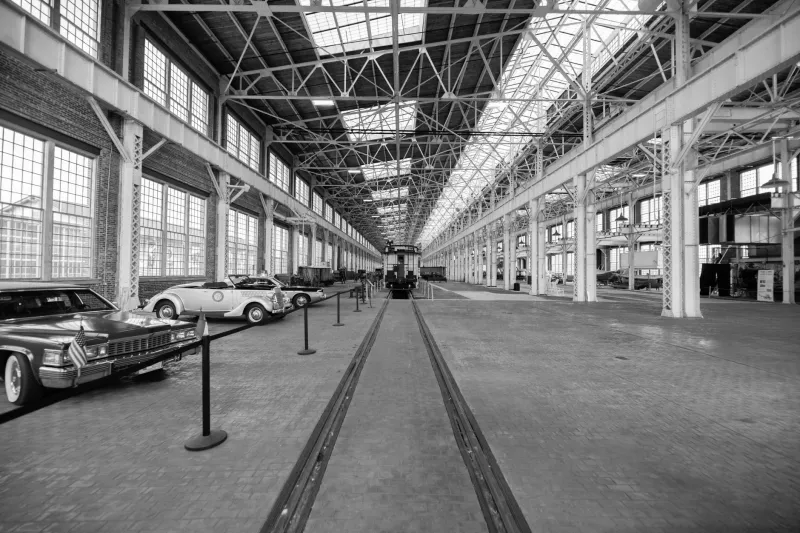
By 1994, the Mercer Industrial & Americana Museum opened its doors — technically, just one door, on a Saturday morning, with a handwritten sign and no advertising budget. Eleven people showed up. Dale counted them.
What Made It Different
The thing about Dale's museum that nobody expected — including Dale — was that it wasn't curated like a traditional institution. There was no academic framework, no grant-funded mission statement, no advisory board of historians. What there was, instead, was an almost physical sense of story.
Every object in the building had a provenance Dale knew personally. The gas station pumps from a foreclosed Route 40 station. The factory time-clock from a shuttered foundry outside Chillicothe. The diner counter from a Columbus lunch spot that went under in 1987. He didn't just display these things — he labeled them with the actual stories. Not sanitized institutional histories, but real ones. "This clock punched in 214 workers on their last day of employment, March 3rd, 1983."
Visitors responded to that honesty in a way that surprised everyone in the regional museum community. Word spread slowly, then faster. A feature in Midwest Living magazine in 2001 brought in visitors from five states in a single weekend.
Earning the Title He Never Studied For
Dale never went back for a GED. He never took a museum studies course or attended a curatorial conference — at least not until people started inviting him to speak at them. When the Ohio Historical Society quietly reached out in 2003 to ask if he'd consider formalizing the museum's status as a nonprofit and accepting some technical support, he said yes, but only if they didn't try to change what made the place work.
They agreed. And the partnership, unlikely as it looked on paper, held.
Today, the museum draws upward of forty thousand visitors a year. It has a permanent education partnership with three county school districts and a rotating exhibit program that has hosted pieces from the Smithsonian's traveling collections. Dale Mercer — who still drives a truck sometimes, just because he likes to — holds the title of Executive Director.
He keeps the spiral notebook in a display case near the front entrance. It's not labeled. Most visitors walk right past it. But if you ask him about it, he'll stop whatever he's doing and tell you the whole story.
The Vault Hidden in Plain Sight
What Dale Mercer built wasn't just a museum. It was proof that expertise doesn't always come from the places we expect it to. His education happened in foreclosed driveways and predawn parking lots, in the gap between what something was worth and what the world was willing to pay for it.
He learned preservation by watching things nearly disappear. He learned curation by refusing to let them.
The repo man saw what the appraisers missed: that loss, handled carefully enough, can become legacy.