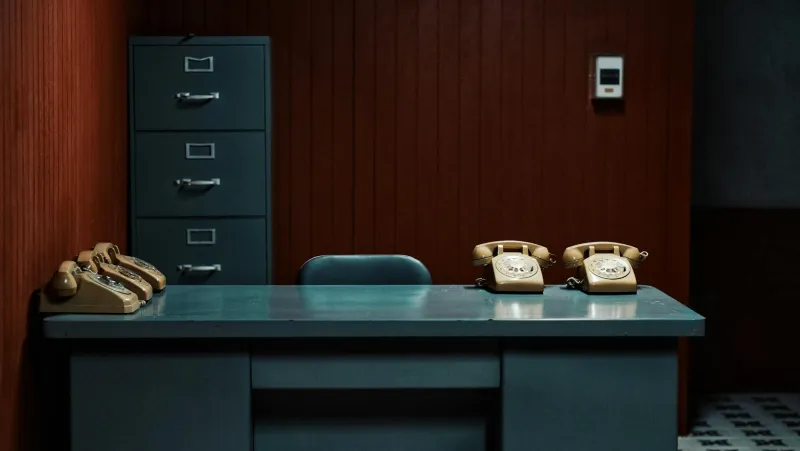
The Woman Behind the Desk
Every morning at exactly 7:45 AM, Eleanor Hartwell placed a fresh cup of coffee on her boss's desk, arranged his schedule, and became invisible. For the next eight hours, she answered phones, typed letters, and filed reports while the executives around her made decisions that affected thousands of employees and millions of dollars.
 Photo: Eleanor Hartwell, via images.fineartamerica.com
What none of them knew was that Eleanor Hartwell was running the show.
From 1952 to 1975, Hartwell worked as a secretary at Consolidated Manufacturing, a Chicago-based company that produced everything from kitchen appliances to industrial equipment. She started at eighteen, straight out of high school, earning $32 a week to support her widowed mother and younger brother. The job was supposed to be temporary — just until something better came along.
 Photo: Consolidated Manufacturing, via www.propools.com
Something better never came along. Instead, something extraordinary happened: Eleanor Hartwell discovered that being invisible gave her a kind of power that corner offices and executive titles never could.
The Art of Strategic Invisibility
Hartwell's transformation from secretary to shadow CEO began with small observations. She noticed that important memos often sat unread on executives' desks for weeks. She saw that critical decisions were delayed because the right people never seemed to be in the same room at the same time. She watched as good ideas died not because they were bad, but because they got lost in the bureaucratic maze.
"Eleanor had this way of making things happen without anyone realizing she was making them happen," recalls James Patterson, a former Consolidated engineer. "You'd mention a problem to her on Monday, and by Friday it was somehow solved, but you could never quite figure out how."
Hartwell's method was simple but revolutionary: she became the company's unofficial information hub. While executives focused on their individual departments, she developed a bird's-eye view of how the entire organization functioned — and more importantly, where it didn't function.
When she noticed that the engineering department was redesigning a component that the manufacturing department had already perfected six months earlier, she "accidentally" left both sets of blueprints on her boss's desk with a note suggesting they might want to compare notes.
When she realized that two departments were ordering the same supplies from different vendors at different prices, she "mistakenly" delivered one department's invoice to the other department's manager.
When she observed that important meetings were consistently delayed because key personnel were double-booked, she began "helpfully" coordinating schedules across departments.
The Memo That Changed Everything
Hartwell's most significant intervention came in 1963, during what company historians now call the "Great Reorganization Crisis." Consolidated's board had hired an expensive consulting firm to restructure the company's operations. After six months of analysis, the consultants recommended a complete overhaul that would have eliminated hundreds of jobs and fundamentally altered how the company operated.
The proposal was scheduled for final approval at the October board meeting. Three days before the meeting, Hartwell was typing the implementation timeline when she noticed something that had escaped everyone else's attention: the consultants' recommendations were based on outdated organizational charts and incorrect production figures.
The consultants had been working from documents that were eighteen months old. They didn't know about the efficiency improvements the manufacturing team had implemented. They weren't aware of the new quality control processes that had reduced defects by 40%. They had no idea that the "redundant" positions they wanted to eliminate were actually critical to the company's recent success.
Hartwell faced a dilemma. She couldn't simply walk into the boardroom and announce that the consultants were wrong — she was just a secretary. But she also couldn't let the company make a catastrophic mistake based on bad information.
Her solution was characteristically subtle. She prepared a "summary memo" for her boss that happened to include all the correct, up-to-date information the consultants had missed. She arranged for copies of recent production reports to be "accidentally" included in the board packets. She "mistakenly" scheduled the heads of manufacturing and quality control to give brief presentations before the main meeting — presentations that would highlight exactly how well the current system was working.
The Meeting That Never Happened
The October board meeting lasted fifteen minutes. After reviewing Hartwell's "summary" and hearing from the department heads, the board unanimously rejected the consultants' recommendations. The company saved an estimated $2.8 million in restructuring costs and avoided what would have been a disastrous reorganization.
Nobody ever knew that a secretary had single-handedly prevented the company from making the biggest mistake in its history.
"Eleanor had this incredible ability to see the big picture," says Margaret Foster, who worked as Hartwell's assistant from 1968 to 1973. "The executives were all focused on their own little kingdoms, but she understood how everything fit together. She could see problems coming from miles away."
The Network Nobody Noticed
By the late 1960s, Hartwell had quietly established herself as the nerve center of Consolidated Manufacturing. Department heads who couldn't get their bosses' attention would "casually mention" problems to Eleanor. Engineers with innovative ideas would "happen to leave" their proposals on her desk. Managers dealing with interdepartmental conflicts would "accidentally" schedule meetings when Eleanor was around to "help coordinate."
Hartwell never sought credit for her role in solving these problems. Instead, she perfected the art of making solutions appear to emerge naturally from the people who were supposed to be in charge.
When the company needed to improve communication between departments, Hartwell didn't write a proposal for a new communication system. Instead, she began "accidentally" including relevant people in meeting invitations and "mistakenly" copying them on important memos until cross-departmental collaboration became routine.
When production schedules were consistently behind, Hartwell didn't suggest a new scheduling system. Instead, she began "helpfully" tracking deadlines and "reminding" managers about potential conflicts until the scheduling problems disappeared.
When quality control issues were causing customer complaints, Hartwell didn't recommend new procedures. Instead, she began "inadvertently" routing customer feedback to the right engineers and "accidentally" scheduling follow-up meetings until quality improvements became standard practice.
The Retirement That Revealed Everything
In 1975, at age 41, Eleanor Hartwell announced her retirement. She was getting married and moving to California with her new husband. Her farewell party was a small affair — cake in the break room and a modest gift from her colleagues.
What happened next surprised everyone. Within six months of Hartwell's departure, Consolidated Manufacturing began experiencing the kinds of problems it hadn't seen in over a decade. Communication between departments broke down. Production schedules slipped. Quality control issues resurged. Important decisions were delayed or forgotten entirely.
"It was like the company's nervous system had been removed," recalls Patterson. "Suddenly nobody knew what anyone else was doing. Projects that should have taken weeks were taking months. We couldn't figure out what had changed."
The answer, of course, was Eleanor Hartwell. For twenty-three years, she had been the invisible force that kept Consolidated running smoothly. She had been the early warning system that prevented problems, the communication network that connected isolated departments, and the institutional memory that ensured nothing important was forgotten.
The Legacy of Invisible Leadership
It took Consolidated's new management team two years to understand what they had lost when Hartwell retired. By then, they had hired three additional coordinators, implemented two new communication systems, and brought in another consulting firm to analyze their "sudden" efficiency problems.
The consultants' conclusion was remarkably similar to what Eleanor Hartwell had been doing all along: the company needed better information flow, improved coordination between departments, and someone with a comprehensive understanding of how all the pieces fit together.
In 1978, Consolidated created a new position: Director of Organizational Coordination. The job description could have been written about Eleanor Hartwell's daily routine twenty years earlier.
"Eleanor proved that real leadership isn't about having the biggest office or the fanciest title," says Foster. "It's about understanding how things actually work and having the patience to make them work better, one small improvement at a time."
Today, business schools teach courses on "informal leadership" and "organizational intelligence" — concepts that Eleanor Hartwell pioneered simply by paying attention and caring enough to act on what she observed.
Her story reminds us that the most powerful person in any organization might not be the one whose name is on the door. Sometimes it's the person who answers the phone, files the reports, and quietly makes sure that everything else can function the way it's supposed to.
The secretary who secretly ran the show proved that influence doesn't require authority — sometimes it just requires the wisdom to see what needs to be done and the skill to make it happen without anyone noticing you're doing it.