Scribbling in the Shadows: How a Night Watchman's Doodles Broke Into America's Most Elite Gallery
The Midnight Artist
Marcus Chen never intended to become an artist. At 22, after dropping out of art school because he couldn't afford the tuition, he took whatever work he could find. First came the dish pit at an all-night diner, then security shifts at office buildings, and finally a job monitoring an empty parking garage from 11 PM to 7 AM.
Most people would have found the isolation maddening. Chen found it liberating.
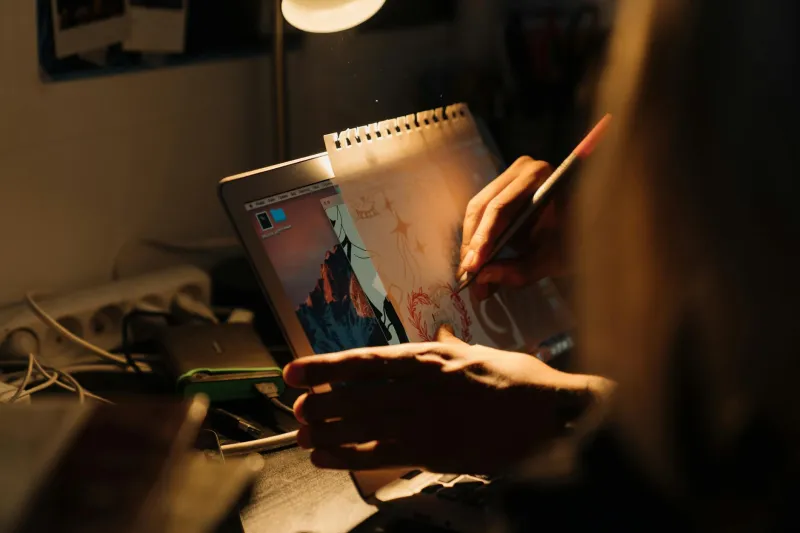
While the city slept, he drew. On napkins from the diner. On the backs of incident reports. On scraps of cardboard he found in dumpsters. His subjects were whatever surrounded him in those quiet hours: the geometric patterns of parking spaces under fluorescent lights, the faces of late-night stragglers, the way shadows fell across concrete walls.
The Education Nobody Planned
Chen's artistic education happened in reverse. While his former classmates studied color theory and art history in climate-controlled studios, he was teaching himself to see in the harsh light of a parking garage. Without professors to guide his hand or critique his work, he developed techniques that were entirely his own.
"I didn't know I was doing anything wrong," Chen later recalled. "I just drew what I saw, the way I saw it."
His isolation from the art world became his greatest asset. Uninfluenced by trends or academic expectations, Chen's work evolved into something completely unique. His drawings captured urban loneliness with a raw honesty that formally trained artists often struggled to achieve.
Eight Years of Sketches
For nearly a decade, Chen's art existed in a vacuum. He filled shoebox after shoebox with drawings, never showing them to anyone. His apartment became a paper museum of midnight observations—thousands of sketches documenting the unseen hours of American cities.
During the day, he slept. At night, he worked and drew. It was a rhythm that kept him separate from the conventional art world, but it also kept his vision pure.
The breakthrough came in 2019, when Chen's building was being renovated. A construction worker found several boxes of his drawings in a storage room and, intrigued by what he saw, showed them to his sister—who happened to work at a small gallery in downtown Portland.
Recognition Finds Its Way
The gallery owner, Sarah Martinez, had seen thousands of portfolios over her career. But Chen's work stopped her cold.
"These weren't drawings trying to be something else," Martinez said. "They were completely honest. You could feel the fluorescent lights, smell the night air, hear the emptiness. It was like discovering a secret diary of urban America."
Martinez organized Chen's first exhibition in 2020. The show, titled "Night Shift," featured 47 drawings created during his years as a security guard. Local art critics were divided—some dismissed the work as untrained, while others recognized something unprecedented.
The Portland show caught the attention of Dr. Eleanor Vasquez, a curator at the Smithsonian American Art Museum. Vasquez had built her career identifying artists who captured authentic American experiences, and Chen's work represented something she'd been searching for: art that emerged from the actual rhythms of working-class life.
The Call That Changed Everything
When the Smithsonian called, Chen was working his usual shift. He almost didn't answer—who calls a parking garage at 3 AM?
"Mr. Chen," came the voice on the other end, "this is Dr. Vasquez from the Smithsonian. We'd like to discuss acquiring some of your work for our permanent collection."
Chen thought it was a prank. It took three more calls and an email with official letterhead before he believed it was real.
Inside the Institution
In 2021, fifteen of Chen's drawings entered the Smithsonian's permanent collection. The acquisition represented more than just recognition—it was validation that art could emerge from anywhere, created by anyone willing to pay attention to the world around them.
The museum's exhibition, "Unseen Hours: The Night Drawings of Marcus Chen," drew record crowds. Visitors were captivated by the intimacy of the work, the way Chen had found beauty in spaces most people hurry through without looking.
"These drawings remind us that art isn't made in studios," Dr. Vasquez wrote in the exhibition catalog. "It's made wherever someone takes the time to really see."
The Unlikely Path Forward
Chen still works nights, though now by choice rather than necessity. He's traded the parking garage for a studio, but he maintains the same hours that shaped his artistic vision. The isolation that once seemed like a limitation has become his signature.
His story challenges everything we think we know about artistic success. No formal training, no connections, no gallery representation—just eight years of persistent observation and an unwillingness to stop drawing, even when no one was watching.
"The garage taught me that art isn't about having the right credentials," Chen reflects. "It's about having something to say and finding your own way to say it."
Today, Chen's work hangs in one of America's most prestigious institutions, proof that sometimes the most unlikely paths lead exactly where they need to go. His midnight sketches, born in the margins of minimum-wage work, now speak to millions of visitors about the hidden poetry of American life.
The dropout who doodled in parking garages had found his way home—not to the art school that couldn't afford to keep him, but to a place where his unique vision could finally be seen.