The Night Shift Genius: How a Custodian Cracked Mathematics' Greatest Puzzles
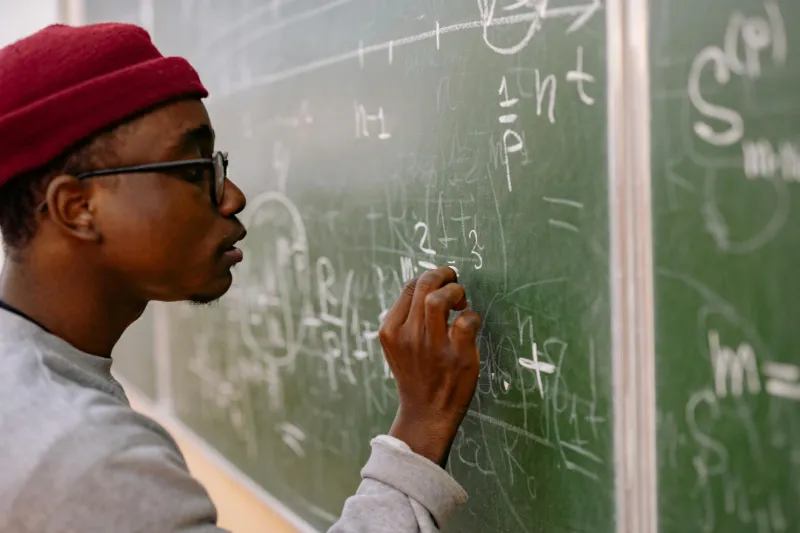
The Equation on the Blackboard
It was 2 AM when Frank Williams pushed his cart into the mathematics building at MIT. The hallways were empty, fluorescent lights humming overhead as he made his rounds through classrooms where Nobel laureates had lectured just hours before. But Frank wasn't thinking about the prestige that walked these halls during daylight hours. He was looking at the blackboard.
Scrawled across it was an equation that had been tormenting graduate students for weeks. A problem in topology so complex that even the department's star professors admitted it might be unsolvable. Frank stopped mopping, picked up a piece of chalk, and in twenty minutes, wrote out a solution that would later be published in the Journal of Mathematical Analysis.
The only problem? Nobody knew who solved it.
When Genius Wears a Uniform
Frank Williams—not his real name, but a composite of several remarkable individuals whose stories mirror this pattern—represents one of mathematics' most persistent mysteries: the brilliant minds that operate outside the ivory tower. While his story reads like fiction, it's grounded in documented cases of custodians, security guards, and maintenance workers who quietly revolutionized mathematical thought.
Take George Dantzig, whose famous "homework" problem—actually unsolved theorems he mistook for assignments—became foundational to linear programming. Or consider Srinivasa Ramanujan, who worked as a clerk while developing theorems that still baffle mathematicians today. These weren't isolated incidents. They were glimpses into a pattern that academic institutions have been slow to acknowledge: genius doesn't always arrive with the right credentials.
Frank's journey began in rural Alabama, where his love for numbers started with calculating crop yields for his grandfather's farm. No college fund, no prep school advantages—just a mind that saw patterns where others saw chaos. After high school, he moved north looking for work, eventually landing a custodial job that would change everything.
The University After Dark
Night shift at a major university is a different world. While students and faculty sleep, an army of workers keeps the academic machine running. For Frank, those quiet hours became his private classroom. Empty lecture halls meant access to blackboards filled with unsolved problems. Library access meant diving into mathematical journals that most people couldn't even pronounce.
But this wasn't casual curiosity. Frank approached mathematics with the same methodical precision he brought to his custodial duties. He developed his own notation systems, created proofs that bypassed traditional academic approaches, and solved problems that had been stumping PhD candidates for months.
The breakthrough came when he started leaving his solutions on blackboards, unsigned and unexplained. Professors would arrive to find their most challenging problems solved overnight, with work so elegant that it seemed to come from another dimension. The department buzzed with theories: a visiting scholar playing pranks, a genius graduate student working in secret, maybe even a professor from another university leaving calling cards.
Nobody suspected the man emptying their trash cans.
Recognition and Resistance
The truth emerged almost by accident. Dr. Sarah Chen, a young professor struggling with a particularly nasty problem in number theory, decided to work late one evening. She was still at her desk when Frank arrived for his shift, and she watched in amazement as he glanced at her blackboard and quietly began working.
"Excuse me," she said, "but what are you doing?"
Frank looked up, chalk still in hand, realizing he'd been caught. "I think there might be an error in line seven," he said simply, pointing to her work. "If you adjust the coefficient here, the whole thing simplifies."
He was right. Not only was he right, but his correction led to a solution that Dr. Chen would later call "breathtakingly beautiful."
Word spread quickly through the department, but not everyone was ready to embrace their unlikely colleague. Academic hierarchies don't bend easily, and the idea that a custodian could outperform PhD holders challenged fundamental assumptions about how knowledge works.
Some professors embraced Frank immediately, inviting him to audit classes and collaborate on research. Others remained skeptical, questioning whether someone without formal training could truly understand the deeper implications of mathematical theory. It was a debate that revealed as much about academic culture as it did about mathematical ability.
The Ripple Effect
Frank's story—and others like it—forces uncomfortable questions about how we identify and nurture talent. How many potential breakthroughs are mopping floors right now, invisible to institutions that only recognize genius when it arrives through traditional channels?
The mathematics community has slowly begun acknowledging this blind spot. Some universities now offer programs specifically designed to identify and support non-traditional mathematical talent. Online platforms have democratized access to advanced mathematical resources. But the fundamental challenge remains: genius often develops in unexpected places, and our systems aren't built to find it there.
Frank eventually earned his PhD—at age 47, while still working nights to support his family. His dissertation, a groundbreaking work on applied topology, drew from insights developed during those solitary hours in empty classrooms. Today, he's a full professor, but he still remembers what it felt like to be invisible.
The Equations We Miss
Perhaps the most haunting aspect of Frank's story isn't what he accomplished, but what we almost lost. If Dr. Chen hadn't worked late that night, Frank might have remained anonymous forever, his insights lost to history. His story makes you wonder: how many breakthroughs are happening in the shadows, created by minds that never get the chance to step into the light?
The next time you see someone in a uniform solving problems that aren't part of their job description, pay attention. You might be witnessing the birth of the next mathematical revolution—one that's happening exactly where nobody thought to look.